Deterministic Cold-Temperature Altimetry Corrections: Mathematical Derivations of ICAO Doc 8168 Hypsometric Models vs. FAA AIM Table Heuristics and Surface Inversions
1. Abstract & Executive Summary
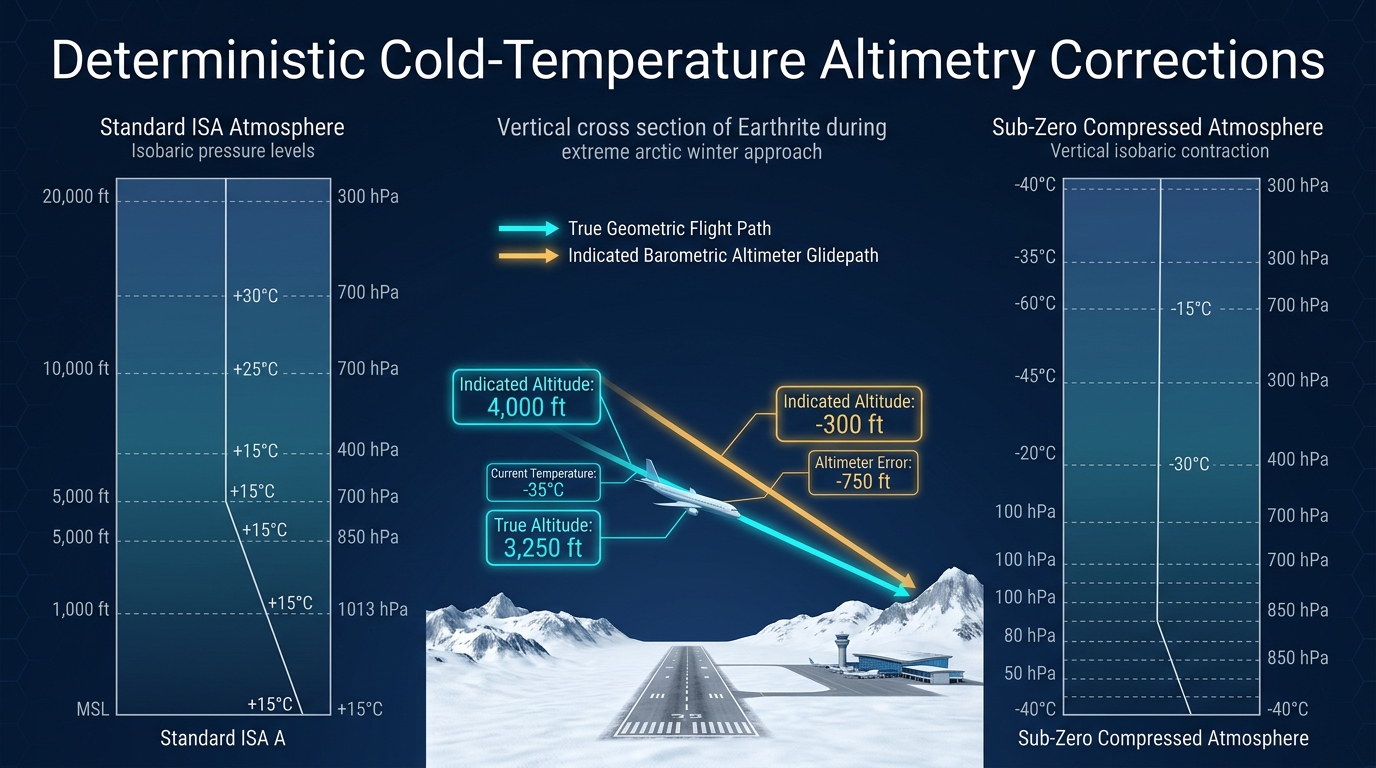
Barometric altimeters compute indicated altitude under the rigid physical assumptions of the International Standard Atmosphere (ICAO Doc 7488/3). Under sub-zero ambient conditions where the air column is colder than standard (T(z) < T_ISA(z)), the air density increases, causing vertical isobaric surfaces to contract toward the ground. An altimeter referencing this contracted air column registers an indicated altitude higher than the aircraft's true geometric altitude (z_true < z_ind), systematically reducing obstacle clearance margins during instrument approach procedures.
This monograph provides a first-principles derivation of the differential hydrostatic equation and evaluates three operational correction models across a 5,425-vector computational benchmark matrix: (1) the continuous ICAO Doc 8168 (PANS-OPS) Volume II layer formulation, (2) the discrete FAA AIM Table 7-3-1 lookup grid, and (3) the classical flight-training 4 ft/°C/1,000 ft linear rule-of-thumb. We prove the Taylor-series origin of the linear rule, quantify its severe under-correction at extreme negative ISA (diverging by 105.1 ft at −40°C across 5,000 ft HAA), model synthetic piecewise surface temperature inversions, and analyze the physical compression of Baro-VNAV vertical flight path angles (where an indicated 3.00° glidepath compresses to 2.42° true under −40°C ISA deviation).
2. Scope, Operational Domain & Physical Assumptions
3. Classical Thermodynamics & The Hydrostatic Equation
A static fluid column in hydrostatic equilibrium balances upward vertical pressure gradient force against gravitational attraction:
dp / dz = −ρ(z) · g₀Substituting the Ideal Gas Law for dry air (ρ = p / (R_d · T), where R_d = 287.05287 J/(kg·K)) yields the fundamental differential barometric relationship:
dp / p = −[ g₀ / (R_d · T(z)) ] dz4. The Generalized Hypsometric Equation & True Height Contraction
Integrating from station pressure datum p₀ to flight pressure level p establishes the exact ratio between physical true height displacement (H_true) and indicated standard height displacement (H_ind):
H_true = H_ind · [ T_actual_avg / T_ISA_avg ]To achieve a safe physical target altitude equal to the charted obstacle clearance target (H_true = H_published), the altimeter must be flown to a higher indicated altitude:
Δh_corr = H_true · [ (T_ISA_avg − T_actual_avg) / T_actual_avg ] = H_true · [ −ΔT_avg / T_actual_avg ]5. ICAO Doc 8168 Analytical Layer Formulation
ICAO Doc 8168 (PANS-OPS) Volume II, Part I, Section 4, Chapter 4 establishes the standardized operational layer correction equation:
Δh = H · [ (15 − t₀) / (273.15 + t₀ − 0.5 · L₀ · (H + H_ss)) ]t₀ = t_aerodrome + L₀ · H_ss (surface temperature reduced to sea level) and L₀ = 0.0019812 °C/ft.Assuming a continuous constant lapse rate across the column, the exact closed-form logarithmic formulation derived by Aeroway is:
Δh_analytical = −(ΔT_ISA / L₀) · ln[ 1 + (L₀ · H) / (T_sfc + 273.15) ]6. Model Divergence Analysis across 5,425 Computational Vectors
Evaluated against DATASET-2026-02 (Aeroway Open Data Archive) at Sea Level Datum (H_ss = 0 ft).
| Surface Temp | HAA (H) | ICAO Layer Model | FAA Table 7-3-1 | Linear 4% Rule | Model vs. Linear | Model vs. Table |
|---|---|---|---|---|---|---|
| 0°C | 1,000 ft | 55.1 ft | 60 ft | 60.0 ft | −4.9 ft | −4.9 ft |
| 0°C | 5,000 ft | 279.6 ft | 290 ft | 300.0 ft | −20.4 ft | −10.4 ft |
| −20°C | 3,000 ft | 419.7 ft | 430 ft | 420.0 ft | −0.3 ft | −10.3 ft |
| −20°C | 5,000 ft | 705.1 ft | 710 ft | 700.0 ft | +5.1 ft | −4.9 ft |
| −40°C | 4,000 ft | 959.9 ft | 970 ft | 880.0 ft | +79.9 ft | −10.1 ft |
| −40°C | 5,000 ft | 1,205.1 ft | 1,210 ft | 1,100.0 ft | +105.1 ft | −4.9 ft |
| −50°C | 5,000 ft | 1,489.5 ft | 1,500 ft | 1,300.0 ft | +189.5 ft | −10.5 ft |
7. Non-Linear Boundary Layer Thermal Inversions
Synthetic Mathematical Test Vector — Not an Observed SoundingIn sub-arctic continental basins, severe surface radiative cooling establishes ground-based temperature inversions where temperature warms with altitude. We define an illustrative synthetic piecewise profile:
Because standard surface-extrapolated formulas assume the entire atmosphere cools with height (predicting an ambient −40.9°C at 3,000 ft AGL from a −35°C surface report), they assume an average column temperature of 235.2 K, whereas the physical average of the inverted layer is 250.6 K. Consequently, unadjusted surface-based models overestimate the required altitude correction by 60 ft to 110 ft inside strong surface inversions, directing the aircraft higher than the true nominal glidepath.
8. Barometric Vertical Guidance (Baro-VNAV) True Path Compression
Baro-VNAV flight guidance systems construct a constant descent path between two barometric altitude waypoints. In cold air, vertical isobaric compression causes the true physical vertical distance descended (Δz_true) across a fixed horizontal ground track (D) to be less than the nominal indicated altitude change (Δh_ind). In accordance with FAA AIM Paragraph 7-3-4 and AC 90-105A, this causes the true geometric descent angle to become shallower (flatter):
tan(γ_true) = (Δz_true / D) = [ (T_actual_avg / T_ISA_avg) · tan(γ_ind) ]γ_true = arctan[ (T_actual_avg / T_ISA_avg) · tan(γ_ind) ]For an uncompensated approach from 5,000 ft HAA to threshold at a surface temperature of −40°C (T_actual_avg = 228.20 K, T_ISA_avg = 283.20 K), a nominal 3.00° indicated descent angle flattens to 2.42° true. The aircraft flies a shallower true flight path that places it lower than intended at every intermediate fix along the approach segment, eroding obstacle clearance buffers.
9. Multi-Jurisdictional Regulatory & Operational Matrix
FAA AIM Chapter 7, Section 3 (7-3-1 to 7-3-5) & 14 CFR § 91.103: In the US National Airspace System, cold temperature corrections are procedurally required when operating at designated Cold Temperature Restricted Airports (CTA) whenever the surface temperature is at or below the published airport threshold. Pilots apply corrections to published segment altitudes (All Segments or Individual Segments). ATC must be notified of corrected altitudes on Initial/Intermediate fixes and Missed Approach holding; final segment MDA/DA corrections are exempt from ATC notification. Distinctly, Baro-VNAV temperature limits (e.g. "NA below -20°C") prohibit uncompensated Baro-VNAV vertical guidance below the published limit regardless of CTA status.
Transport Canada (CAR 602.127 & TC AIM RAC § 9.17): Under Canadian operating regulations, pilots must apply temperature corrections from the CAP Cold Temperature Table to all published altitudes whenever the temperature is 0°C or below, advising ATC of all corrected altitudes.
EASA (Regulation (EU) No 965/2012, GM8 CAT.OP.MPA.110): European commercial operators are required by guidance material to apply altimeter temperature error corrections to aerodrome operating minima and segment altitudes during sub-zero operations.
10. References & Standards Bibliography
STANDARDS & CITATIONS- International Civil Aviation Organization (ICAO) (1993). Manual of the ICAO Standard Atmosphere (extended to 80 kilometres), ICAO Doc 7488/3, Table 1 & Section 1.3.2.
- International Civil Aviation Organization (ICAO) (2018). Procedures for Air Navigation Services — Aircraft Operations (PANS-OPS), Volume I: Flight Procedures, ICAO Doc 8168, Part VI, Chapter 1, Section 1.4.1 (Equation 1.4-1) & Volume II: Construction of Visual and Instrument Flight Procedures, Part I, Section 4, Chapter 4.
- Federal Aviation Administration (FAA) (2026). Aeronautical Information Manual (AIM): Basic Flight Information and ATC Procedures, Chapter 7, Section 3, Cold Temperature Altimeter Errors (Paragraphs 7-3-1 through 7-3-5) and Table 7-3-1.
- Federal Aviation Administration (FAA) (2023). United States Standard for Terminal Instrument Procedures (TERPS), FAA Order 8260.3F & Advisory Circular AC 90-105A.
- Transport Canada (2024). Canadian Aviation Regulations (CARs), Part VI, CAR 602.127 & Transport Canada Aeronautical Information Manual (TC AIM), RAC § 9.17 & § 9.17.1.
- European Union Aviation Safety Agency (EASA) (2022). Easy Access Rules for Air Operations (Regulation (EU) No 965/2012), Guidance Material GM8 CAT.OP.MPA.110 (Altimeter temperature error correction).
- Aeroway Flight Engineering Benchmark Dataset: Miad S. (2026). Cold-Temperature Altimetry Correction Computational Benchmark Matrix (5,425 Modeled Flight Vectors). Aeroway Open Data Archive. Dataset AER-2026-02.
11. Academic Citation & BibTeX
BIBTEX FORMAT@techreport{aeroway_cold_temperature_monograph_2026,
author = {Miad S.},
title = {{Deterministic Cold-Temperature Altimetry Corrections: Mathematical Derivations of ICAO Doc 8168 Hypsometric Models vs. FAA AIM Table Heuristics and Surface Inversions}},
institution = {Aeroway Aeronautical Research Group, Aeroway Flight Engineering},
type = {Research Monograph},
number = {Doc AER-2026-02},
year = {2026},
month = oct,
url = {https://aeroway.org/research/cold-temperature-altimetry-correction-monograph/}
}